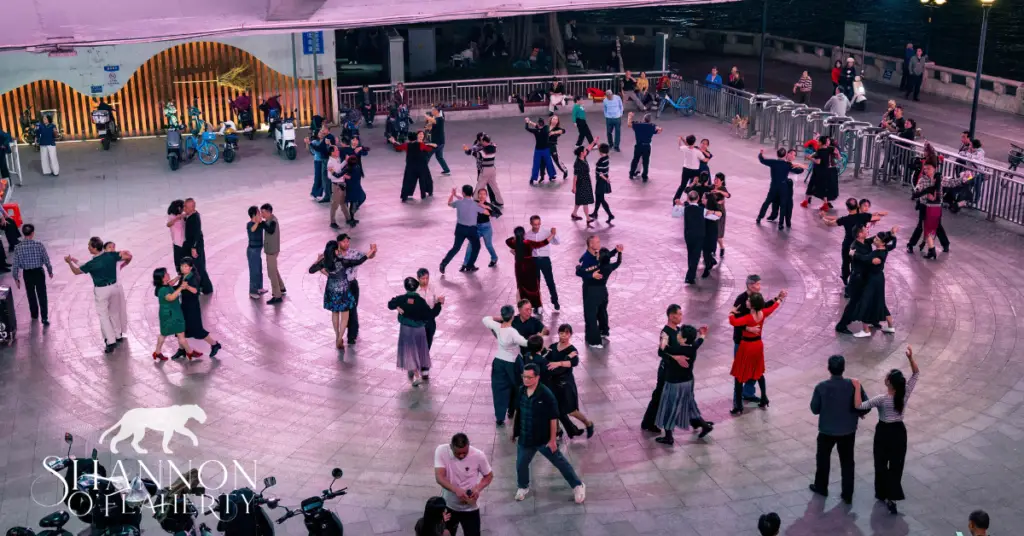
I have said this to my clients, my sons, friends and to strangers at parties, and I will say it here in writing so it is official: if you do not know what to do with what you are feeling, go and dance.
Not because it fixes everything. Because it moves everything.
I have been doing Ceroc and freestyle dancing for years now, and I did not come to it as a wellness practice. I came to it because I love it. But twenty five years of working with the nervous system, with birth trauma, with the body’s stored stories, has shown me that dancing is doing something far bigger than “fun exercise.” It is medicine. Let me show you why.
The Physical Layer: Your Body Was Built To Move Like This
Dancing is one of the few forms of movement that asks your whole body to participate at once. Your feet, your hips, your spine, your arms, your face. It is cardiovascular work disguised as joy. Your heart rate climbs, your balance sharpens, your coordination improves, and you are building strength and flexibility in ways a treadmill never will, because a treadmill doesn’t ask you to turn, lead, follow, or catch yourself mid laugh when you miss a step. I also googled what the equivalent of a 2 hour ceroc freestyle was in terms of walking and the answer was a 7 – 10 mile hike! Even better because your body is twisting, turning, side stepping using even more energy than just hiking alone.
And here is the part most people miss. Dance is weight bearing, rhythmic, and repetitive in the exact way that helps regulate a dis-regulated nervous system. If you have ever felt anxious energy trapped in your chest or your jaw, dancing gives that energy somewhere to go. It discharges what talking alone cannot.
The Brain Benefits: Dancing Builds A Better Brain
This is the part that lights me up as a facilitator who works with belief work and neural pathways. Dancing is one of the most complex things you can ask your brain to do. You are processing music, timing, spatial awareness, memory of steps, and in partner dancing, the unspoken communication between you and another person, all simultaneously.
Research on cognitive reserve has repeatedly pointed to dance as one of the most protective activities for brain health as we age, more so than many other forms of exercise, precisely because of this multitasking demand. You are literally building new neural pathways every time you learn a new sequence or respond to an unfamiliar lead. For those of us doing belief work and rewiring old patterns, this matters. New movement patterns support new thought patterns. The body leads the mind more often than the mind leads the body.
Find the dancing that works for you! If it’s not Ceroc or Modern Jive there are classes available in Tango, Salsa, Swing Northern Soul and even 5 Rhythms. And if you can’t find a class, dancing around in your kitchen or living room is better than not dancing at all!
The Emotional Layer: Where The Feelings Actually Live
I work with birth trauma and ancestral patterns held so deep in the body that no amount of talking will shift them. And what I know, in my bones, is that emotion is not just a thought. Emotion is energy in motion. It is meant to move.
Dancing gives grief, joy, anger, longing, and everything in between, a legitimate exit. You do not have to explain what you are feeling on the dance floor. You just move it. I have watched people cry mid dance and come off the floor lighter, not because anything was resolved in words, but because something old finally got to leave the body.
The Social Layer: Warm and Fuzzy Strokes, In The Transactional Analysis Sense
Here is where I want to slow down, because this part does not get talked about enough.
In Transactional Analysis, a “stroke” is a unit of recognition. Eric Berne, who founded TA, described it as the fundamental unit of social interaction, and his famous line was that we all need strokes the way we need food, or we wither. A smile from a stranger is a stroke. A compliment is a stroke. Being asked to dance is a stroke. Being held, even briefly, in a partner dance hold, is a stroke.
Most adults are touch starved and recognition starved without even realizing it. We go days being seen only through a screen. And then you walk into a dance room and within twenty minutes you have danced with five different people, or someone has told you they love your dress, someone else has laughed at something you did on the floor, and your whole nervous system exhales. That is not small. That is deeply nourishing contact, freely given, in a space where it is completely normal to receive it.
This is part of why I think dancing solves something therapy alone often cannot. It gives you a socially sanctioned way to receive warm, physical, joyful attention from other humans, on a regular basis, without needing to explain yourself or perform anything other than showing up.
And Yes, The Dressing Up Matters Too
I will not apologise for loving this part. There is something in putting on a dress (or your favourite outfit) that makes you feel like yourself, or more than yourself, doing your hair, choosing the earrings, that is its own small ceremony. It says, I am worth dressing up for. Tonight I get to be seen.
That is not vanity. That is a woman honouring her own aliveness. And when you combine that feeling with music, movement, and the warmth of other people delighted to dance with you, you have built yourself an entire ecosystem of joy in a single evening.
The Answer
So when someone asks me what to do with anxiety, with grief, with a body that will not settle, with a heart that feels under fed, I keep coming back to the same answer. Go and dance. Put on the outfit. Let your body do what talking cannot. Let a stranger’s hand on yours remind you that you are still wanted in a room.
Dancing will not solve every problem you carry. But it will move what is stuck, feed what is starved, and remind you, in your body, before your mind even catches up, that you are still very much alive.
If any of this stirred something in you, especially around old patterns your body has been carrying longer than you realized, that is exactly the kind of work we do together. Book a Truth Map Call and let us look at what wants to move.